

RuneScape Dragonwilds compost unlocks at Farming level 10. Build a Compost Bin from 8 Ash Logs and 4 Stone, then craft a Compost Bucket from 5 Ash Logs at a Crafting Table. Put an accepted material into the bin, allow it to process, equip the bucket, and collect the finished compost from the bottom of the bin. Applying compost to a Farming Plot consumes 10 units at a time, while fully fertilising one plot requires 50 units.
Compost gives a plot a 1.5x yield multiplier and lowers the affected plant's disease rate to 50%. It does not make a crop immune to disease, so watering, plot choice, and disease treatment still matter. The Compost Bucket carries up to 150 units, enough to fully fertilise three plots before it must be refilled.
| Compost fact | Current value |
|---|---|
| Farming level needed to unlock the Compost Bin recipe | 10 |
| Compost Bin materials | 8 Ash Logs and 4 Stone |
| Compost Bucket materials | 5 Ash Logs |
| Processing time for one accepted item | 5 seconds |
| Compost consumed per application | 10 units |
| Compost needed to fully fertilise one plot | 50 units |
| Maximum Compost Bucket capacity | 150 units |
| Fully fertilised plots per full bucket | 3 |
| Listed Farming experience when compost is applied | 10 |
| Crop yield multiplier | 1.5x |
| Disease rate after applying compost | 50% |
Build the Compost Bin and Bucket
The Compost Bin and Compost Bucket form one system. The bin converts unwanted materials, but it does not apply the finished compost directly to crops. The bucket is the tool that removes compost from the bin and carries it to Farming Plots.
Build the Compost Bin through the Build Menu after reaching Farming level 10. Its recipe is:
- 8 Ash Logs
- 4 Stone
The recipe information also lists 12 Construction experience. That value is experience from the build, not a Construction level requirement. Farming level 10 is the stated unlock condition for the recipe.
Craft the Compost Bucket at a Crafting Table. It requires:
- 5 Ash Logs
The bucket can hold normal compost taken from a Compost Bin. Its maximum capacity is 150 units. Because a plot takes 50 units to become fully fertilised, one completely filled bucket covers exactly three plots. Keeping the bin close to the plots shortens the repeated trip between collecting and applying compost, especially when maintaining more than three plots.
Do not plan on moving or destroying a loaded bin immediately. A Compost Bin cannot be destroyed while compost remains stored inside it. Empty the finished compost into an equipped bucket before trying to remove or relocate the structure.
Turn Accepted Items into Compost
Interact with the Compost Bin and deposit an accepted item. Each item takes five seconds to convert. Finished compost collects at the bottom of the bin rather than moving directly into your inventory.
Use this sequence from start to finish:
- Reach Farming level 10 and build the Compost Bin.
- Craft a Compost Bucket at a Crafting Table.
- Put an accepted material into the bin.
- Wait for that material to finish processing.
- Equip the Compost Bucket before interacting with the finished compost.
- Fill the bucket from the processed compost stored at the bottom.
- Take the equipped bucket to a Farming Plot and apply its contents.
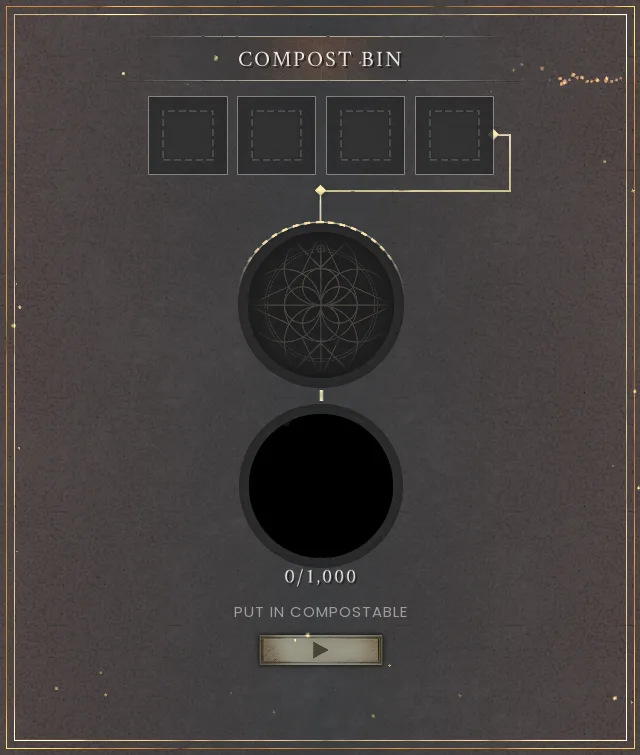
The interface for loading materials and starting compost processing.
The important planning detail is that accepted inputs do not all have the same compost value. Most accepted inputs provide 10 units, but any raw food provides only 1 unit. A single 10-value item supplies one application to a plot. By comparison, ten 1-value raw food items are required for that same 10-unit application.
| Accepted Compost Bin input | Compost value per item |
|---|---|
| Any burnt food | +10 |
| Bloodwood Sap | +10 |
| Shocking Plant Bulb | +10 |
| Animal Bone | +10 |
| Small Animal Fang | +10 |
| Monstrous Fang | +10 |
| Antler | +10 |
| Any herb except Irit | +10 |
| Anima-Infused Bark | +10 |
| Wheat | +10 |
| Feathers | +10 |
| Any plants | +10 |
| Any logs | +10 |
| Any raw food | +1 |
Treat this as an efficiency table, not an instruction to compost every item you own. Five inputs worth 10 units each produce the 50 units required to fill one plot. Reaching the same total with raw food takes 50 items because raw food is worth only one unit apiece.
Burnt food is a particularly clean candidate when it has no better immediate purpose. Spare plants or logs can also provide the full 10-unit value, but they may compete with cooking, crafting, building, or future farming needs. Animal Bones and weeds or other plants can be relevant to disease treatment, so keep enough farming supplies in reserve instead of emptying an entire storage chest into the bin.
The broad phrases in the input list have limits. The herb entry explicitly excludes Irit, and raw food has its own lower value even though several other organic categories are worth 10. If an item does not fit one of the listed accepted categories, do not assume the bin will take it merely because it looks organic.
Apply Compost to Farming Plots
Equip the filled Compost Bucket and use it on the Farming Plot you want to fertilise. Each application transfers 10 units. Continue until the plot has received a total of 50 units if you want it fully fertilised.
Apply the bucket five times to fully fertilise a plot.
Finished compost produced by the Compost Bin.
The listed result is a 1.5x yield multiplier and a reduction of the affected plant's disease rate to 50%. Compost therefore improves output and disease resistance at the same time. It does not reduce the rate to zero, and it is not a substitute for curing a plant that has already become diseased.
Compost also does not replace the rest of the basic crop routine. Preparing a plot deals with weeds, water helps reduce disease, and using a plot suited to a seed's region improves disease resistance. Compost belongs alongside those systems: its distinctive benefit is increased harvest yield, with additional disease protection.
Calculate How Much Compost You Need
Multiply the number of plots by 50 to find the total compost needed for full fertilisation. Divide that total by the bucket's 150-unit capacity to estimate the number of full bucket loads. When the total is not divisible by 150, the final load is only a partial bucket.
| Plots to fertilise | Compost required | Bucket-load plan |
|---|---|---|
| 1 | 50 | One-third of a full bucket |
| 2 | 100 | Two-thirds of a full bucket |
| 3 | 150 | 1 full bucket |
| 4 | 200 | 1 full bucket plus 50 units |
| 6 | 300 | 2 full buckets |
| 8 | 400 | 2 full buckets plus 100 units |
| 10 | 500 | 3 full buckets plus 50 units |
| 15 | 750 | 5 full buckets |
You can also work backwards from your available inputs. Five materials with a +10 compost value fully supply one plot. Fifteen such materials fill a bucket to its 150-unit limit and cover three plots. For raw food at +1, the equivalent figures are 50 items for one plot and 150 items for a full bucket.
Processing time scales with the number of deposited items rather than only with their resulting value. One +10 item takes five seconds and produces enough compost for one application. Producing the same 10 units from ten raw food items requires ten separate conversions. This makes the +10 categories far more efficient when the goal is to prepare several plots with minimal input and processing.
Choose Where Compost Is Worth Using
Composting every plot provides the listed yield and disease benefits, but it also adds five applications to the maintenance of each plot. Whether that effort is worthwhile depends on what the harvest is for.
Prioritise compost when:
- You want the 1.5x yield multiplier from a crop.
- Seed supply or harvested material is limited enough that extra output matters.
- Reducing disease risk is valuable for the current planting cycle.
- You already have plentiful +10 inputs such as unwanted burnt food or spare plants.
- Your plots are close enough to the bin that refilling the bucket is quick.
It can be reasonable to conserve compost when:
- You already have more of that crop than you need.
- The available bin inputs have more important crafting, cooking, or farming uses.
- Most of your proposed input is raw food worth only +1.
- You are maintaining a large number of plots and prefer a shorter routine over the yield bonus.
Skipping compost means giving up its listed bonuses; it does not turn compost into a mandatory cure or watering system. This distinction matters when deciding whether to fertilise every ordinary crop or reserve the supply for harvests where increased yield has a clear purpose.
Fix Common Compost Problems
The Compost Bin recipe is missing
Check the Farming skill first. The recipe unlocks at Farming level 10. The Construction experience shown with the build recipe should not be read as a level requirement.
The bin accepts an item but no compost can be collected
Allow the five-second conversion to finish, then equip the Compost Bucket before interacting with the processed compost at the bottom of the bin. Simply carrying an unequipped bucket is not the collection step described for the station.
The bucket empties before a plot is fully fertilised
A plot requires 50 units in total, delivered in five 10-unit applications. Check how much compost was in the bucket before beginning. A partially filled bucket may run out during the five applications even though its maximum capacity is 150.
The compost supply grows very slowly
Review the input values. Raw food contributes only +1 per item, while the other listed accepted categories contribute +10. Replacing ten expendable raw-food inputs with one expendable +10 input produces the same listed compost value with far fewer conversions.
Crops still become diseased
This is expected. Normal compost lowers the disease rate to 50%; it does not provide complete immunity. Continue using the appropriate plot, water, and disease treatment as needed. Compost improves the odds but cannot guarantee a disease-free crop.
The Compost Bin cannot be destroyed
Remove the compost stored inside it. The bin cannot be destroyed while it still contains compost, so equip the bucket and empty the stored output before attempting to dismantle or relocate the structure.
See Corpse Cotton gathering and planting for the requirements and steps of that next task.