
RuneScape Dragonwilds currently has twelve playable skills, each trainable to level 99. You gain experience by doing the activity associated with the skill: fight with a weapon style, gather resources, grow crops, catch fish, cook food, craft equipment, build structures, make runes, or train movement. Levels provide skill bonuses and unlocks, including utility spells that can change how you gather and travel.
The current twelve are Attack, Magic, Ranged, Mining, Woodcutting, Farming, Fishing, Artisan, Construction, Cooking, Runecrafting, and Agility. Prayer, Hunter, and Slayer are future additions rather than playable training options. Older guides that describe nine skills or a general level fifty cap do not describe the current roster and cap.
The twelve skills and their training actions
Use the table to connect a goal with the action that trains it. A skill category describes the activity family; it does not mean experience is shared automatically across every skill in that category.
| Category | Skill | Training action |
|---|---|---|
| Combat | Attack | Defeat enemies with melee weapons |
| Combat | Magic | Defeat enemies with magic or cast spells |
| Combat | Ranged | Defeat enemies with ranged weapons |
| Gathering | Mining | Mine ore, clay, or stone, or gather loose stones |
| Gathering | Woodcutting | Chop trees, tear up saplings, or collect loose logs |
| Gathering | Farming | Grow crops |
| Gathering | Fishing | Catch fish |
| Artisan | Artisan | Craft weapons, armour, and tools |
| Artisan | Construction | Build structures |
| Artisan | Cooking | Cook food |
| Artisan | Runecrafting | Craft runes and siphon Anima Vents |
| Support | Agility | Run courses and traverse the world |

Choose a training action based on the skill you want to advance, rather than assuming any productive activity awards the same experience. Carrying ore home, crafting a weapon, and building a workshop belong to different stages of a resource chain. They support each other, but they are not interchangeable training methods.
A useful first decision is the concrete unlock you need next. If you are short on a gathering capability, inspect that gathering skill. If you need a rune recipe, inspect Runecrafting. If your obstacle is equipment strength or a missing crafting ingredient, increasing an unrelated skill will not directly complete the recipe. Tie the training target to the problem instead of treating every level as equally urgent.
Combat skills follow the way you fight
Attack is trained through melee combat, Ranged through ranged combat, and Magic through magic or spellcasting. The choice of weapon style therefore affects which combat skill advances while you defeat enemies. Plan that choice around the equipment you intend to use, rather than expecting a bow session to build the same skill as a sword session.
A skill level and an equipment upgrade are separate progression checks. Your broader preparation also includes food, available ammunition or runes, and suitable equipment for the encounter. A higher level is useful, but it does not replace an ingredient you still need to craft the next weapon. Keep the equipment objective and the skill objective visible so one does not hide the other.
Magic also connects combat with utility. Casting spells can contribute to Magic training, while Runecrafting supplies runes for combat magic and utility spells. These two skills have related purposes but different experience actions. Crafting rune supplies at an altar is a Runecrafting activity; using magic is the Magic side of the loop.
If your goal is selecting a weapon, use the weapon guide for that decision. This overview explains which skill the activity trains and how to connect training with progression. It does not require you to adopt a single combat style for every encounter or spend materials on all weapon families at once.
Gathering skills support different resource chains
Mining covers ore, clay, and stone, including loose stones collected from the ground. Woodcutting covers trees, saplings, and loose logs. These activities provide the raw materials used by later crafting and construction. Train the skill associated with the resource you need, and avoid discarding the gathering stage as time spent only preparing for “real” progression.

Mining has several practical milestones: Rocksplosion at level eleven breaks apart boulders and ore; Gem Prospector at sixteen adds the chance for gemstones; and Summon Stone Spirits at twenty-four guides you toward nearby mineable rocks. Later, level thirty-six reduces metal ore weight by twenty-five percent, and level seventy-one reduces ingot weight by fifty percent. These unlocks solve different problems, so choose a target based on gathering, finding resources, or carrying the result.
Tool progression remains a separate check. A Bone Pickaxe reaches Copper and Tin, a Bronze Pickaxe reaches Iron, and an Iron Pickaxe reaches Gold and Coal. A high Mining level does not replace the tool required by a particular node. Woodcutting supports a different resource branch, so gathering logs cannot fix the missing mining tool or perk even when both materials feed the same project.
Farming and Fishing add different supply activities to the roster. Farming advances by growing crops; Fishing advances by catching fish. They are current skills, rather than roadmap placeholders. Cooking is separate again: obtaining a food ingredient does not complete the activity of cooking it, so plan that processing step when you want Cooking experience as well as supplies.
Think of the chain as a sequence of useful actions. Gather or grow the ingredient, process it where needed, and cook or craft the output. Each step has its own skill relationship. This lets you prepare several goals during ordinary play without pretending every item grants the same amount of experience or that every production chain is equally fast.
Artisan, Construction, and Cooking cover different work
Artisan advances when you craft weapons, armour, and tools. Construction advances when you build structures. Cooking advances when you cook food. The names can overlap with ordinary speech, especially because “crafting” sometimes refers to anything made at a base. For training decisions, use the specific skill shown by the recipe rather than the broad meaning of the word.
Building a processing station is part of establishing the workshop; using it afterward can belong to another skill. For example, the station's building recipe can award Construction experience, while its processed output has an Artisan experience award. Do not read the station's experience number as a character level required to use every output it can make.
The same distinction appears in textile projects. Fine Thread and Fine Cloth are processed crafting materials, but they serve different final recipes. Increasing a skill does not eliminate the need to make the named intermediate material. Follow the chain required by your chosen item, and use the skill award attached to each action to understand which level is actually advancing.
Construction can be planned around a useful base addition, rather than building without a current purpose. Cooking can be planned around the supplies you intend to carry. Artisan can follow the equipment or tool upgrade that removes your next bottleneck. These are goal-based training choices; they do not imply a verified fastest method or an experience-per-hour ranking.
Runecrafting has recipe and efficiency milestones
Runecrafting supplies runes for combat magic and utility spells. Its experience comes from making runes at a Rune Altar and siphoning Anima Vents. Mining Rune Essence is the gathering step; it no longer awards additional Runecrafting experience. That distinction is useful if an old guide sends you mining solely to advance Runecrafting.
| Rune | Recipe unlock | Auto-crafting efficiency unlock |
|---|---|---|
| Air | Level 1 | Level 22 |
| Astral | Level 3 | Level 30 |
| Water | Level 11 | Level 58 |
| Earth | Level 15 | Level 68 |
| Fire | Level 25 | Level 75 |
| Nature | Level 38 | Level 87 |
| Law | Level 50 | Level 94 |
A recipe unlock and an efficiency unlock are different milestones. Learning a rune recipe does not mean auto-crafting already has its better yield. Check which benefit the level grants before deciding that a later unlock is a second requirement just to make that rune.
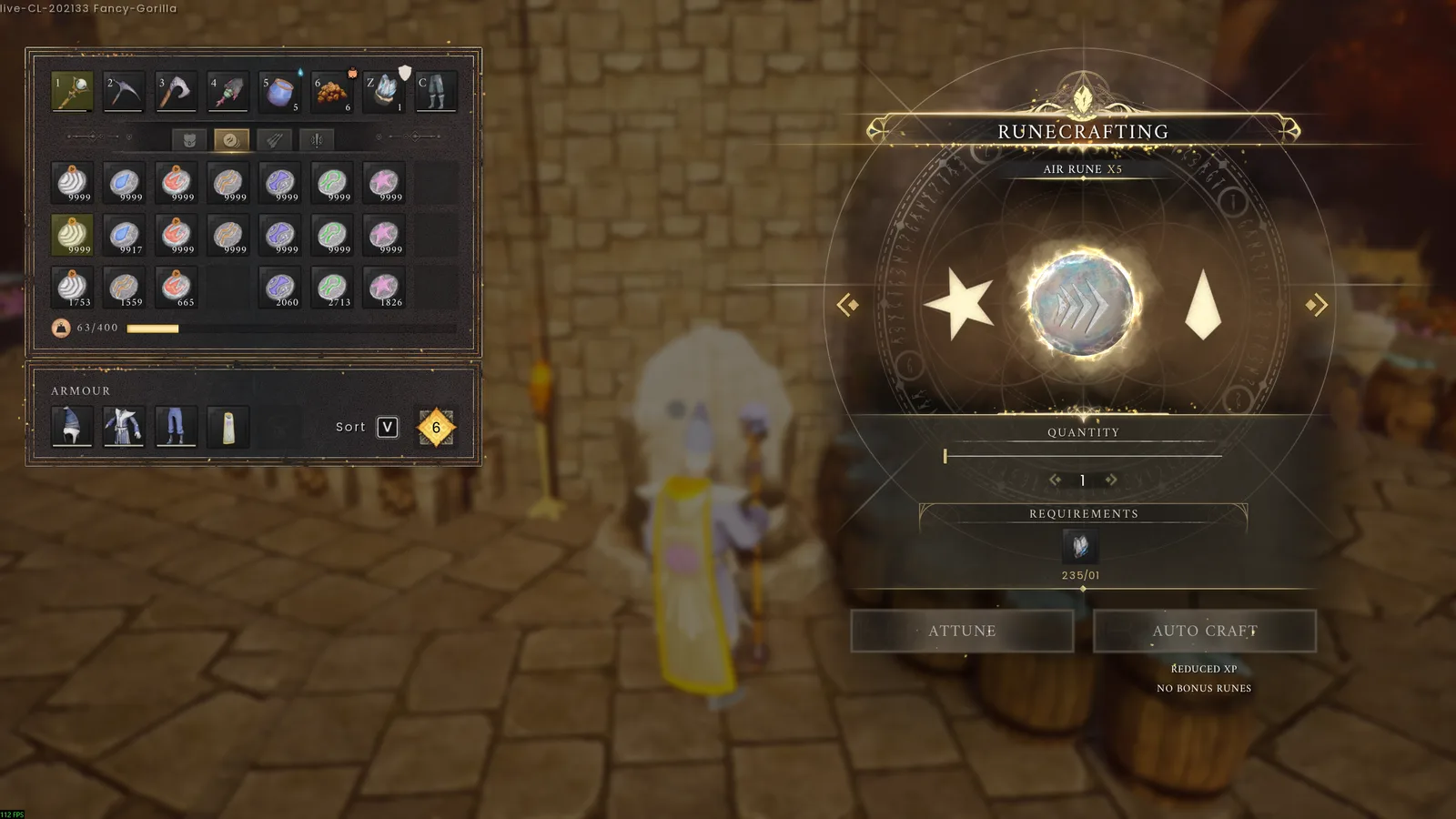
The altar offers Attune and Auto Craft. Attuning uses an Attunement stage followed by an Infusion stage, with the potential for the full available experience and a one-to-ten essence-to-rune ratio. Auto Craft is immediate but gives only 25 percent of the experience, with efficiency upgrades needed for the better ratio. This is a meaningful tradeoff between interaction and the training reward, rather than two identical buttons.
Anima Vents offer another route to rune supplies, including types you cannot yet craft at an altar. Siphoning is possible at any level when you have Rune Essence. For a location objective such as obtaining early Law Runes, use the Law Rune locations guide. You do not have to turn a resource search into a requirement to reach the altar's level fifty recipe first.
Some Runecrafting unlocks directly affect travel and supply: Summon Elemental Spirits at level nineteen helps find nearby vents, and Home Teleport unlocks at level twenty-seven. Later levels add further siphoning, essence recycling, and efficiency benefits. Read the specific unlock you are targeting, because a convenience spell and a rune recipe can solve very different problems.
Agility belongs to the current roster
Agility is the support skill trained through courses and traversing the world. It should appear in your current skill planning alongside Farming and Fishing. A guide written for the initial Early Access roster may omit it, but that omission does not make the present skill a future feature.
Keep Agility's progression separate from an assumption that every movement action grants a known fixed reward. Use the available course and skill information for the activity you intend to train. This overview identifies the skill and its role, without assigning unsupported experience rates, shortcuts, or level requirements to particular routes.
Choose your next training objective
Start with the task blocking progress and identify the skill relationship behind it. This makes the next session easier to finish and verify.
- Name the outcome: a rune recipe, a gathering unlock, a crafted tool, a structure, or a food supply.
- Check the relevant skill and recipe information for the requirement or award.
- Choose an activity that advances that specific skill while producing something you need.
- Separate required levels from experience numbers shown as recipe rewards.
- Check the unlock after reaching the level, then return to the equipment or exploration task it supports.
You can combine compatible goals without claiming a universal priority order. A workshop project may require Mining for raw metal, Artisan for equipment, and Construction for a new station. Rune supply may connect Runecrafting with the Magic spells you plan to use. The right order comes from your current missing prerequisite, rather than an unsupported statement that every player should train the same skill first.
Keep future skills out of present training plans
Prayer is not currently playable. Hunter and Slayer are also future additions, with those two announced among skills planned for 2027. Do not stockpile around an invented current training method or treat a future icon as proof of a working progression system.
All twelve present skills can reach level 99. Historical limits and the original nine-skill roster help explain older videos, but they should not dictate your current target. Use the present list for training and the roadmap guide for announced additions that have yet to arrive.
Related progression guides
- Law Rune locations for supply before the altar recipe unlock.
- Fishing for the fishing activity and its controls.
- Fine Thread for a concrete processing chain with Artisan rewards.
- Roadmap for future skills and announced content.